

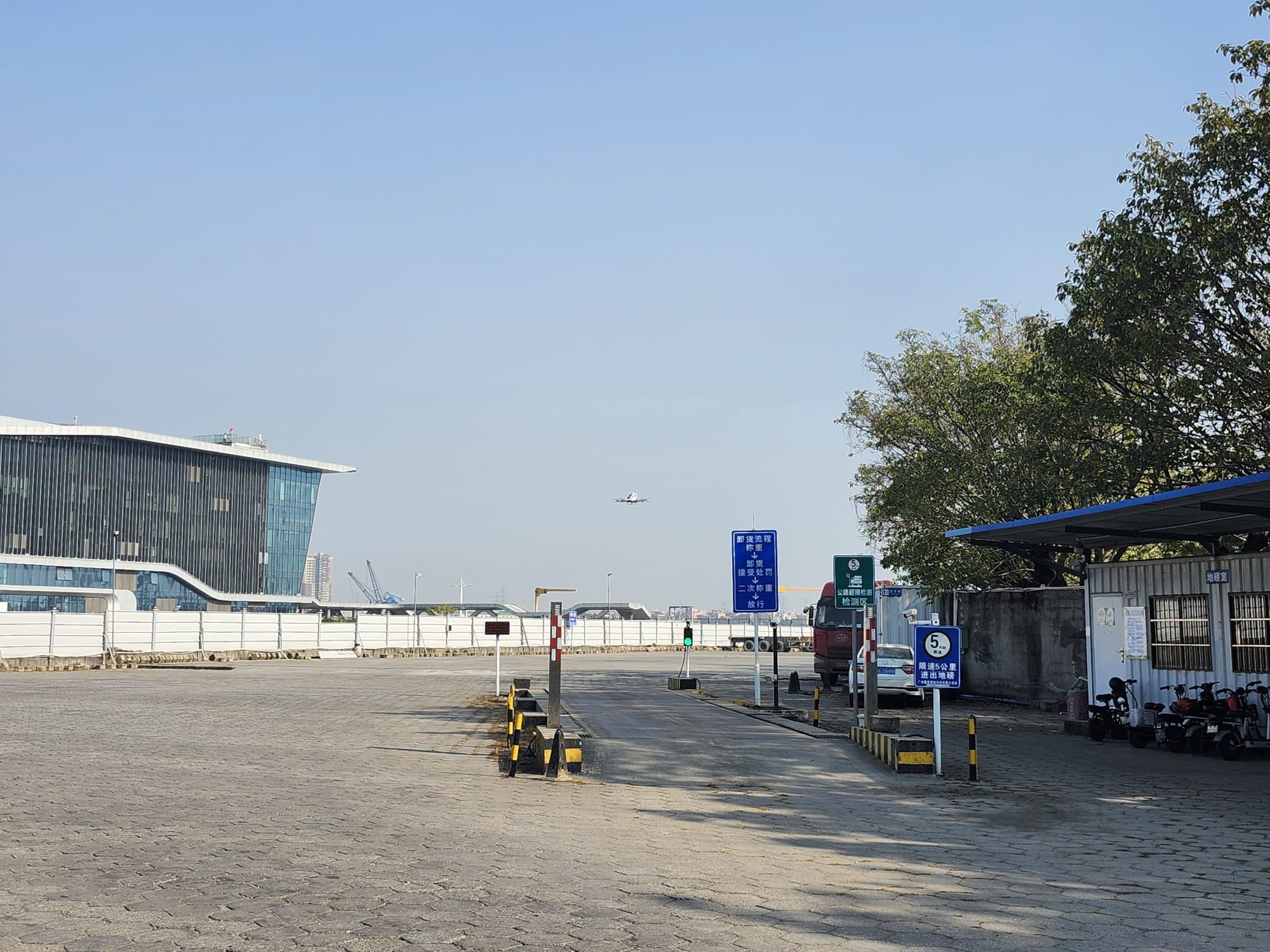
On January 27, 2026, I set off to see the electric flying cars of Guangzhou.
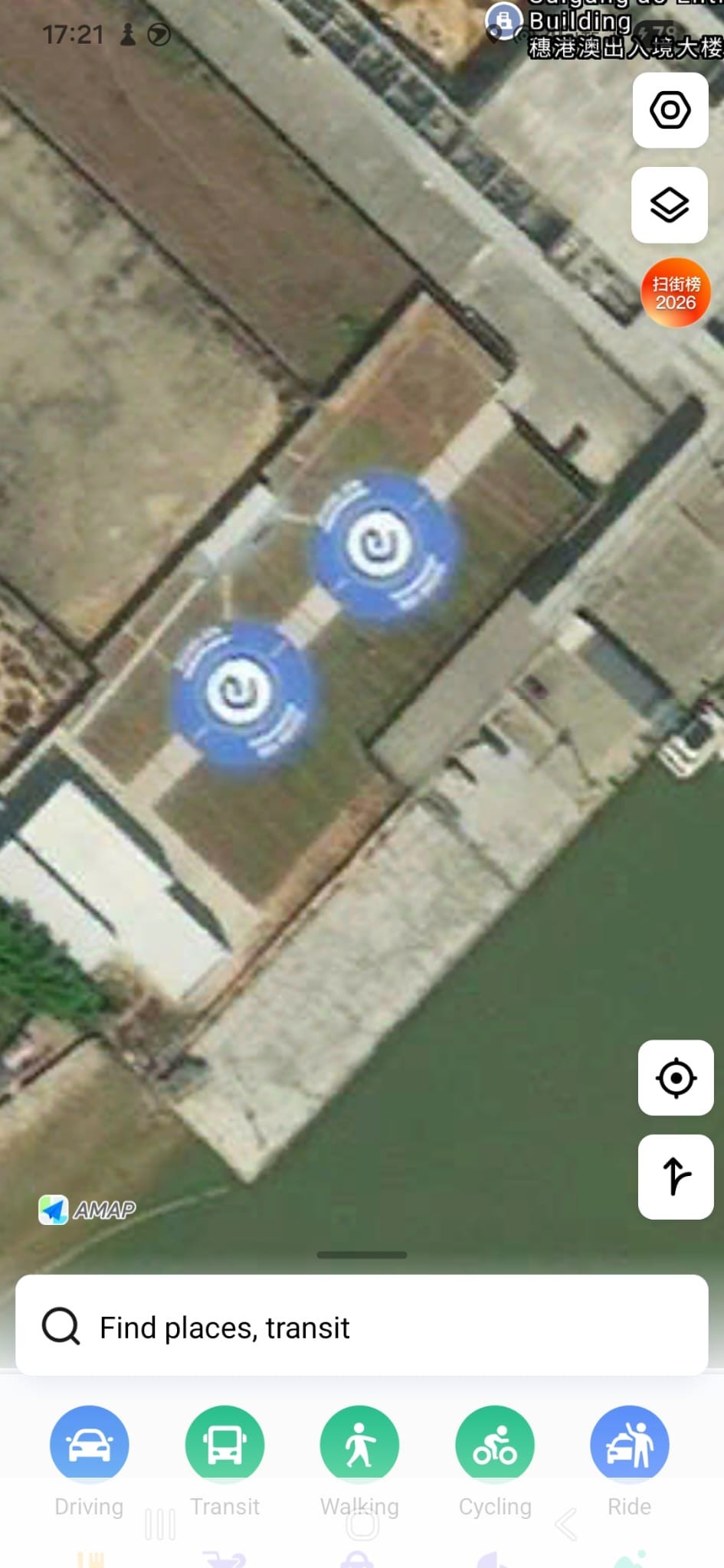
My train had pulled into this great trading city on the Pearl River Delta, formerly known as Canton, the previous afternoon. Earlier, I’d done some online research to find a spot where I might see electric flying cars in this city, cross-checking press releases from leading eVTOL startup EHang mentioning a “Suigang Wharf” testing center in Guangzhou with satellite imagery from Amap (like Google Maps but Chinese) that found EHang-logo landing pads near the river in this port area.
EHang is a world leader in building human-carrying electric vertical takeoff and landing (eVTOL) vehicles. One big advantage of eVTOLs over helicopters is that helicopters generally need to go forward when taking off and so require runways, while eVTOLs can go straight up, enabling possible “flying taxi” uses in cities and maneuverability in crowded landscapes. They’re also much quieter, another plus for city use, and of course they’re 100% battery-powered and zero-emissions!
I got a Didi (like Uber but Chinese) ride in a Chinese-made EV to a point on the map just outside the probable testing grounds. As the car sped towards this goal, I felt a worm of self-doubt curling around my innards. I was pretty sure I’d found the right place, but these test flights weren’t advertised as publicly viewable, and there was no posted schedule or anything. What if security kicked me out of the area? What if they only had one test flight a day, and I’d already missed it? What if they had one test flight a week, and there wouldn’t be another one before I planned to leave China. Maybe I could just get a picture of the landing pads at least, then share some of EHang’s own press photos in the article I hoped to write about eVTOLs.
When my EV rideshare dropped me off near the wharf, I started walking through the parking lot on the adjoining property towards the EHang site. Literally less than a minute after leaving the car, I saw one.
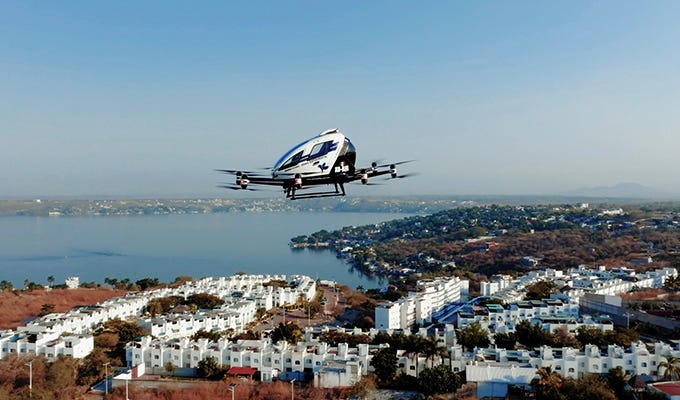
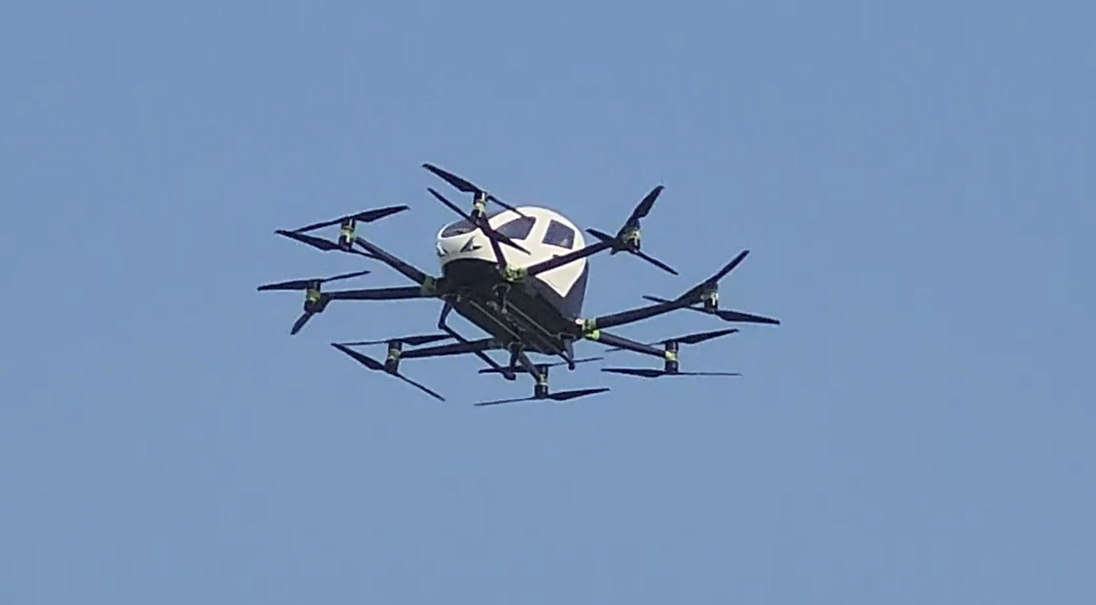
An electric flying car was in the air, right in front of me. Here’s my video.
I couldn’t believe my eyes. My cockamamie plan to go to Guangzhou and write about this cutting-edge technology in my newsletter was working. All the wild futuristic stuff I’d read about eVTOLs was real — it was right in front of me. Like the smaller modern self-stabilizing drones I’d seen, this craft looked like an object from a video game or a 3D-modeling software. When it stood still, it just sat there in the air, perfectly level, as if placed on an invisible shelf. It was genuinely awe-inspiring.
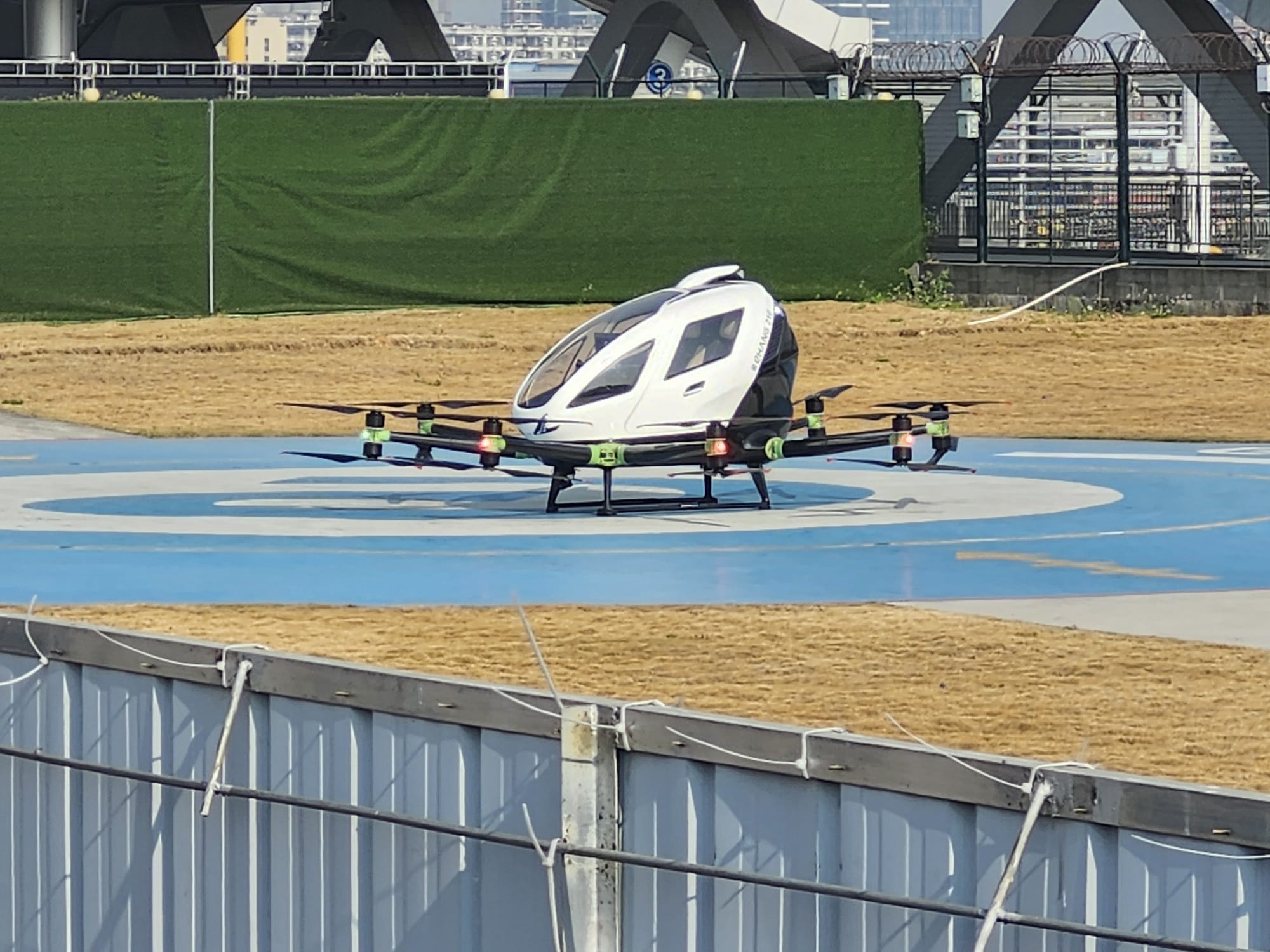
Eventually, it touched down, returning to base. I clambered up onto a rusty truck bed to get a closer look over the wall into the EHang testing grounds. I could clearly see the eVTOL which had just been flying sitting on a blue landing pad.
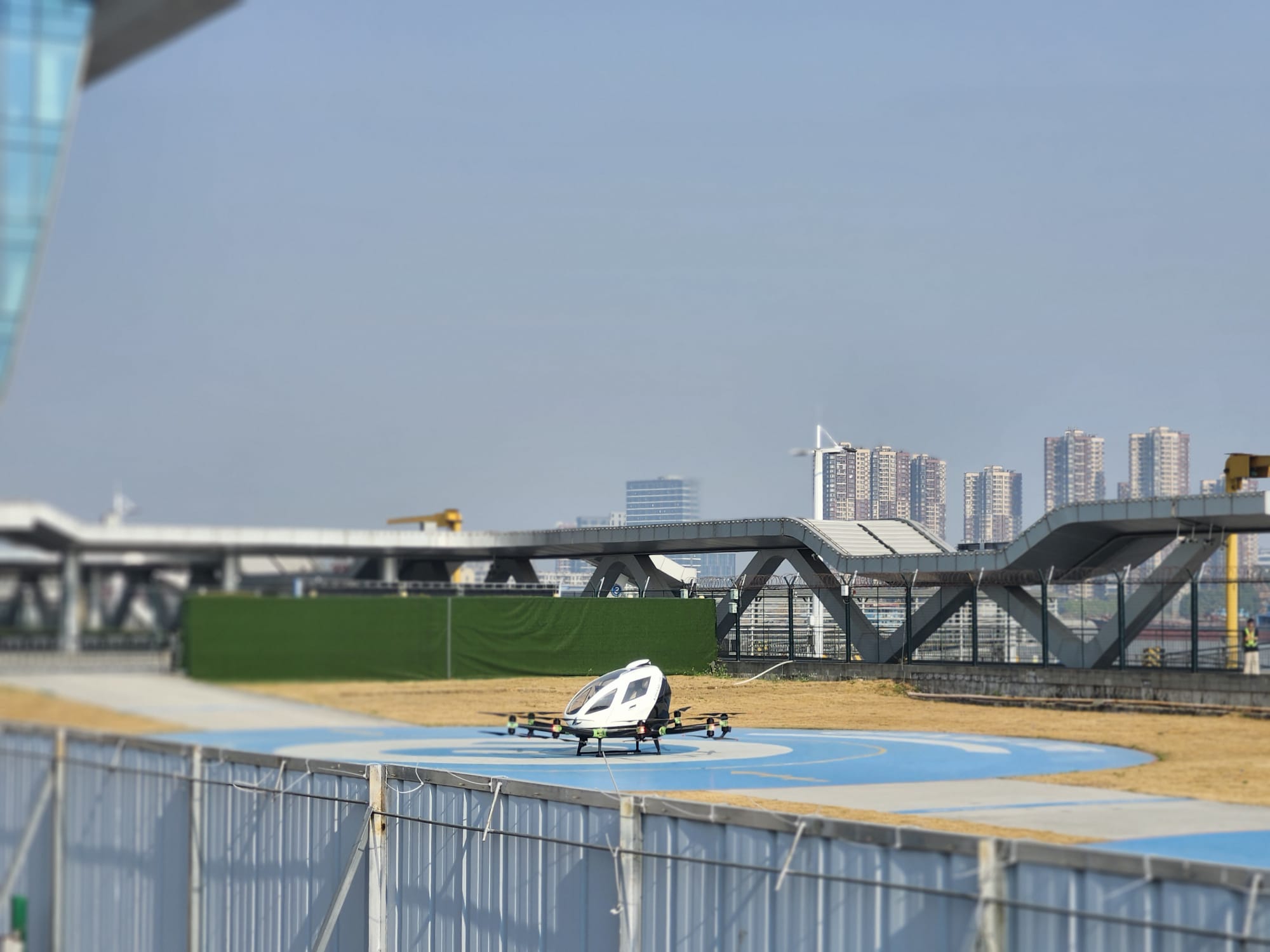
I would tentatively identify it as an EH216-S, a two-seater that’s one of EHang’s most popular models. Notably, it’s pilotless, so this isn’t just an electric flying car, it’s an electric flying driverless car. According to the EHang website, it can be charged in just two hours and has an array of safety systems in place so that their passengers can feel safe alone in driverless flying machines, including preset algorithms that can select the safest route in case of emergency. It looked like the one I was watching had nobody riding in it today, though.
EHang also claims to have completed tens of thousands of test flights and to have “accumulated extensive safe flight data in environments exceeding 3,000 meters in altitude, extreme cold and heat, typhoons, rain, snow, and over rivers, lakes, and seas.”
A few minutes after the first eVTOL had landed, I noticed a second device being tested, a much smaller flying drone framework that clearly couldn’t carry a human. I have no idea what it was for. Maybe package delivery, like America’s Wing drones starting to roll out in partnership with Walmart, or maybe just a testing framework for some new rotor or battery design that would later be added to human-carrying eVTOLs? Here’s my second video.
While I was filming this second video from the elevated truck bed, I could see the EHang employees monitoring the flight, and some of them looked over the wall to see me as well. I smiled, waved, and gave them a big thumbs up. Two of them came over to the wall and looked at me. I wrote “This is so cool” into my Google Translate app, cranked up the volume, and played the Chinese response at them. They smiled back.
I left that area, uploaded the video I’d previously taken to YouTube, and walked around the outside of the EHang property to get a more distant front-angle view of the next test flight. Here’s my next video.
This is just pretty freaking incredible. “Flying cars” are like the archetypal example of pie-in-the-sky futurism that doesn’t pan out. They’re now real. We have them. Engineers made them. New versions are being made all the time. You live in a world with flying cars. You can go to the flying car place and see them. I just did!
eVTOLs may seem like a new toy for rich people at first, but new technology has a habit of starting out that way before becoming cheaper, more accessible, and widely useful. Small quadcopter-type drones also seemed like toys at first, and now they’re doing vital, transformative work from delivering life-saving medical supplies across sub-Saharan Africa to scaling up aerial reforestation around the world. A recent study has found that medical facilities in the Ashanti Region of Ghana that were served by Zipline small delivery drones saw a 56% reduction in maternal deaths compared to the same facilities before drone deliveries! Zipline is also trying to set up drone delivery in America, with healthcare a major priority.

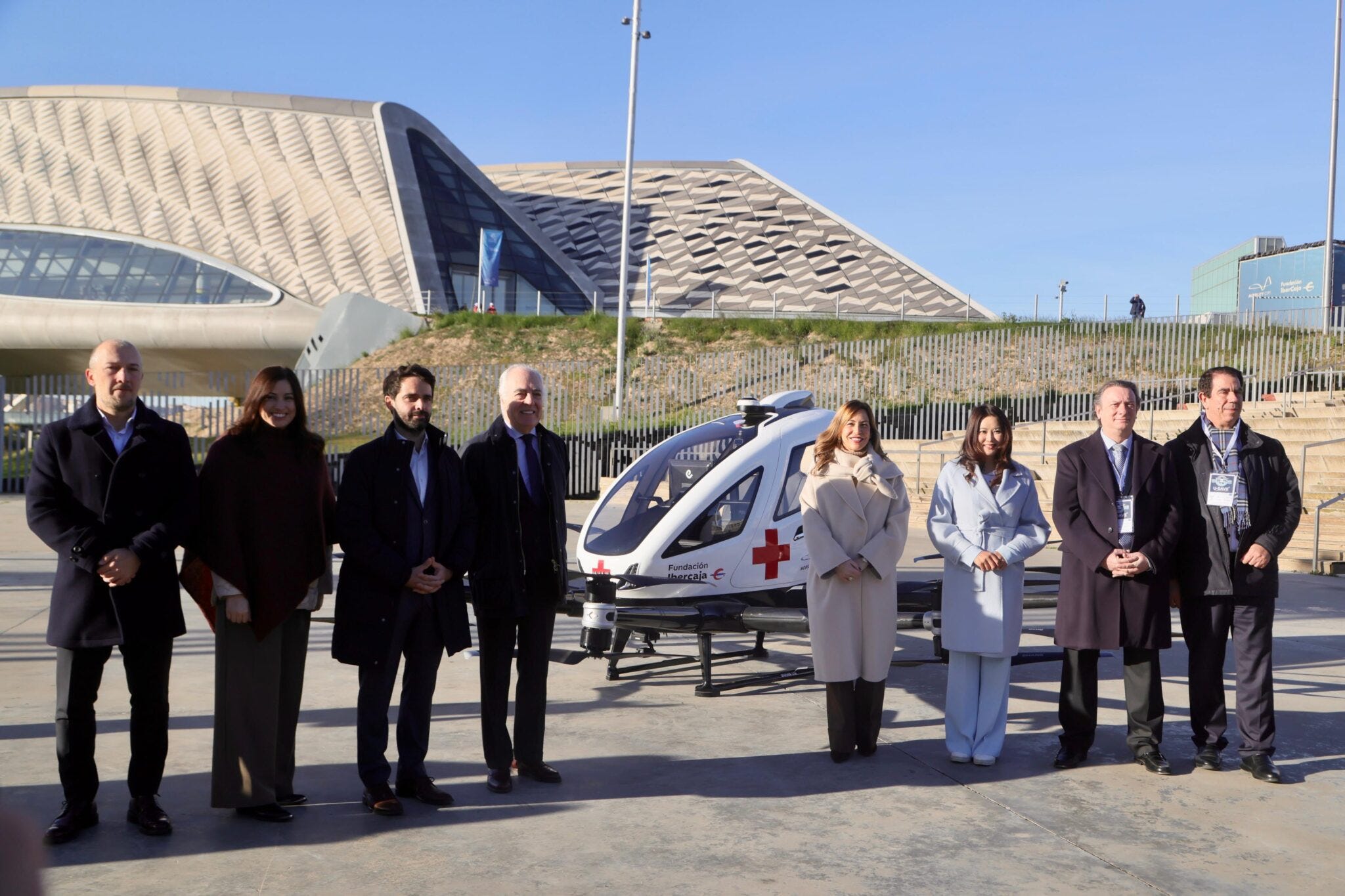
One of the earliest and most important uses of EHang-style human-carrying eVTOLs will likely be as emergency response vehicles, both aerial ambulances and supply-dropping flying trucks. In December 2025, EHang sent one of their EH216 eVTOLs to conduct a first-ever point-to-point demonstration flight in Zaragoza, Spain in partnership with the European Union’s brand-new Urban Supply Aerial Vehicles for Emergencies (U-SAVE) project. U-SAVE reportedly aims to “resolve accessibility and traffic congestion issues in large urban centres during emergencies like fires and floods” making it a disaster resilience effort, a medical first-responder effort, and a decarbonization effort all in one. The flight was successful, demonstrating that eVTOLs could efficiently and rapidly deliver essential supplies if needed.
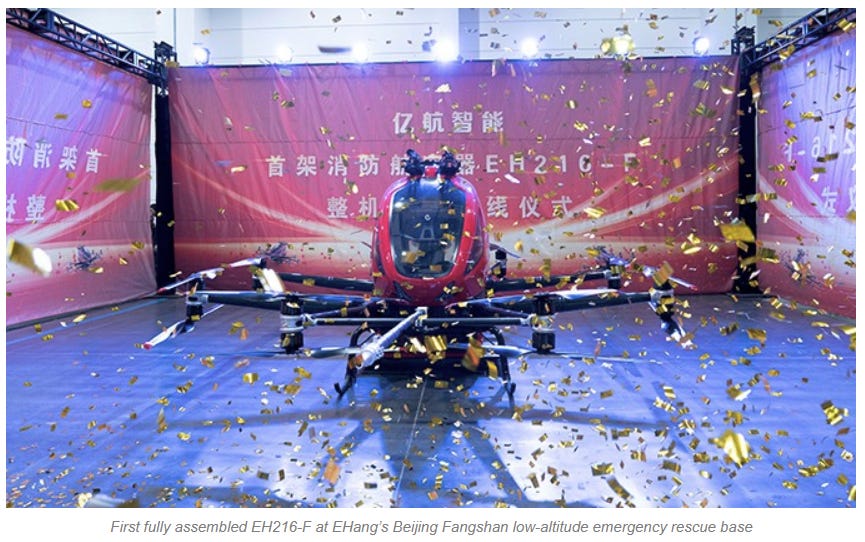
That same month, EHang announced the rollout of their first EH216-F model, designed for firefighting and emergency rescue, in Beijing.
EHang is just one of many startups working on eVTOLs in the broader “low-altitude economy” space, which has increasing regulatory support from China’s government. Other Chinese contenders include Vertaxi, Volant, and EV-maker Xpeng’s AeroHT division.
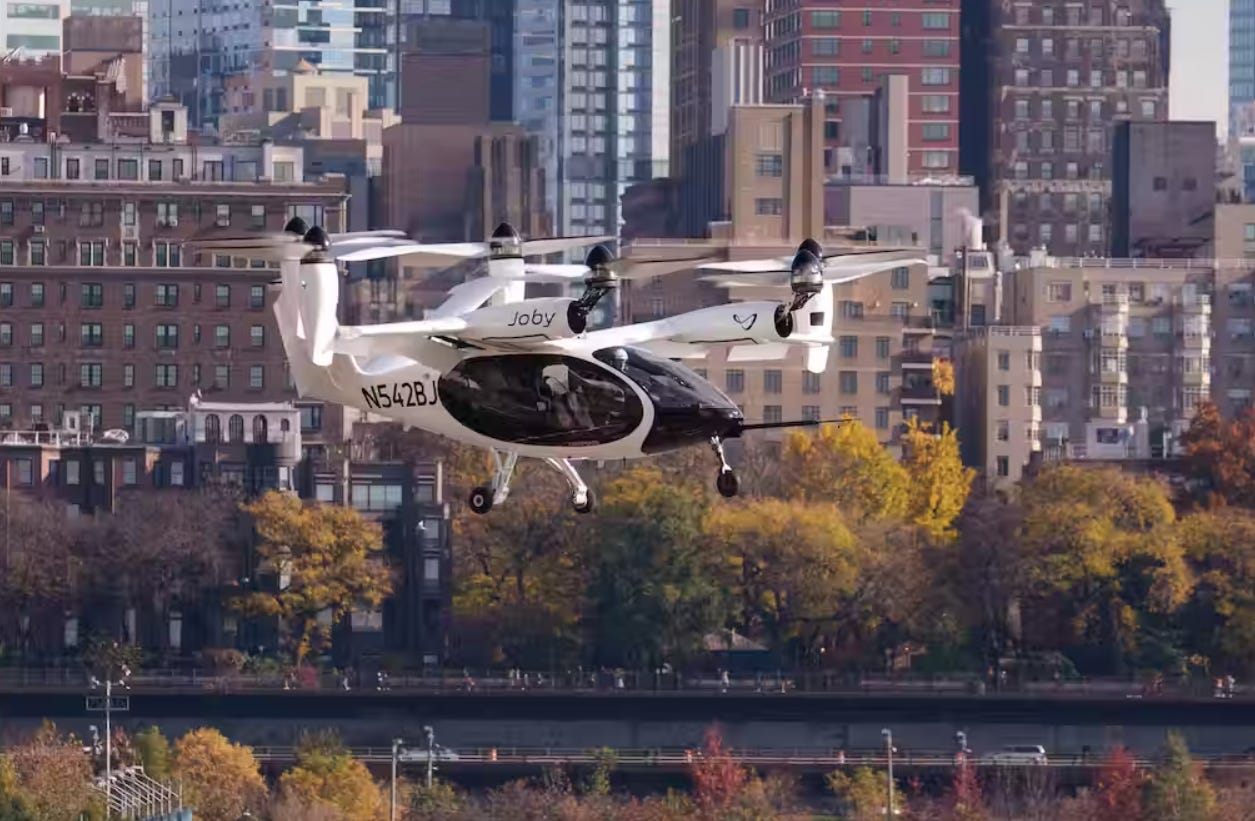
There are also several American startups working on eVTOLs, with Archer, Beta, and Joby already reaching the test flight stage. I’ve written several Climate Action Now signable open letters advocating for U.S. policymakers to actively support and enable eVTOL progress. I would love to see eVTOLs take off across America, and I will continue advocating for that.
However, China’s overwhelming preeeminence in battery manufacturing, plus its absence of a fossil fuel-worshipping political faction that fanatically attacks all efforts to improve battery manufacturing, makes me think that China is poised to lead the rising global Electric Flying Cars Era just like it’s now leading the Electric Cars Era.
Investment in American clean energy manufacturing was booming under Biden, but has “cratered” under the moronic regime currently in the White House, with factory cancellations and layoffs multiplying.
As I was writing this article, the very day I first saw eVTOLs with my own eyes, popular and influential American economics commentator Noah Smith (generally viewed as fairly hawkish on China) published a Substack post concluding that the least bad option for the United States is now to allow the importation of Chinese electric vehicles in exchange for those companies setting up factories in the U.S.

Efforts to establish a competitive U.S. domestic battery supply chain have floundered amid political insanity. Chinese EV companies arriving would at least train some U.S. workers in what is rapidly becoming modern civilization’s central industry, offering hope of eventually building the capacity to allow American battery manufacturing to compete globally. Chinese EV-makers are alreading building local cleantech factories from Brazil to Hungary to Indonesia; this is an established model. Plus, of course, this would offer immense affordability and air quality benefits just by selling cheap clean cars. The U.S. does still have some domestic battery factories doing great work, often supported by farsighted state governments, but the insane headwinds they have to deal with are presented them from scaling up anywhere near as fast as China’s titans.

In addition to within-one-city sky taxis and emergency response, EHang is already talking about city-to-city or even region-to-region eVTOL flights. One recent test successfully traversed 22 kilometers in 18 minutes to cross the Qiongzhou Strait from Hainan to Guangdong, the company’s first-ever flight between two different provinces. With extensive testing starting to transition to real-world applications in multiple Chinese cities, I suspect that eVTOLs might very quickly follow the path pioneered by solar panels and EVs — within a few years, China could be exporting clean, cheap flying electric cars around the world. It might be just a bit harder for internal combustion engine dead-enders to argue for fossil fuel superiority when the electric vehicles aren’t just cleaner, cheaper, and safer, they’re also flying.
Fundamentally, the rise of eVTOLs is just an immensely positive-sum development, a big step forward for humanity and yet another incredible examples of the wonders brought by the Electrotech Revolution. As I’ve previously written, it’s really a massive step up for adaptation and resilience as well as an incredibly cool new zero-carbon transport method. In any future epidemic or pandemic, an eVTOL and/or drone delivery network would enable much faster distribution of drugs, vaccines, personal protective gear, and medical professionals. During climate disasters like hurricanes, floods, or wildfires, delivery drones could deliver essential survival tools like water purification filters or anti-smoke masks straight to households, and eVTOLs could evacuate people even in areas cut off by damaged roads. This might very quickly become a vital new piece of civilizational infrastructure, a basic everyday transport mechanism to fill the low-altitude gap between planes, trains, and automobiles.
AWESOME technology! I very much look forward to seeing the incredible new zero-emissions creations transforming and upgrading human civilization in the next few years and decades, as we continue forward into the Solar/Battery Age.
The work you do is special!!
It's like solar punk Jetsons, so cool!