

The Hydrological Interventions of Mteza
Africa Annals #11
On May 7, we visited the EarthLungs site of Mteza. This one was much closer to Mombasa, so we thankfully headed out at 7:30 AM instead of 6.
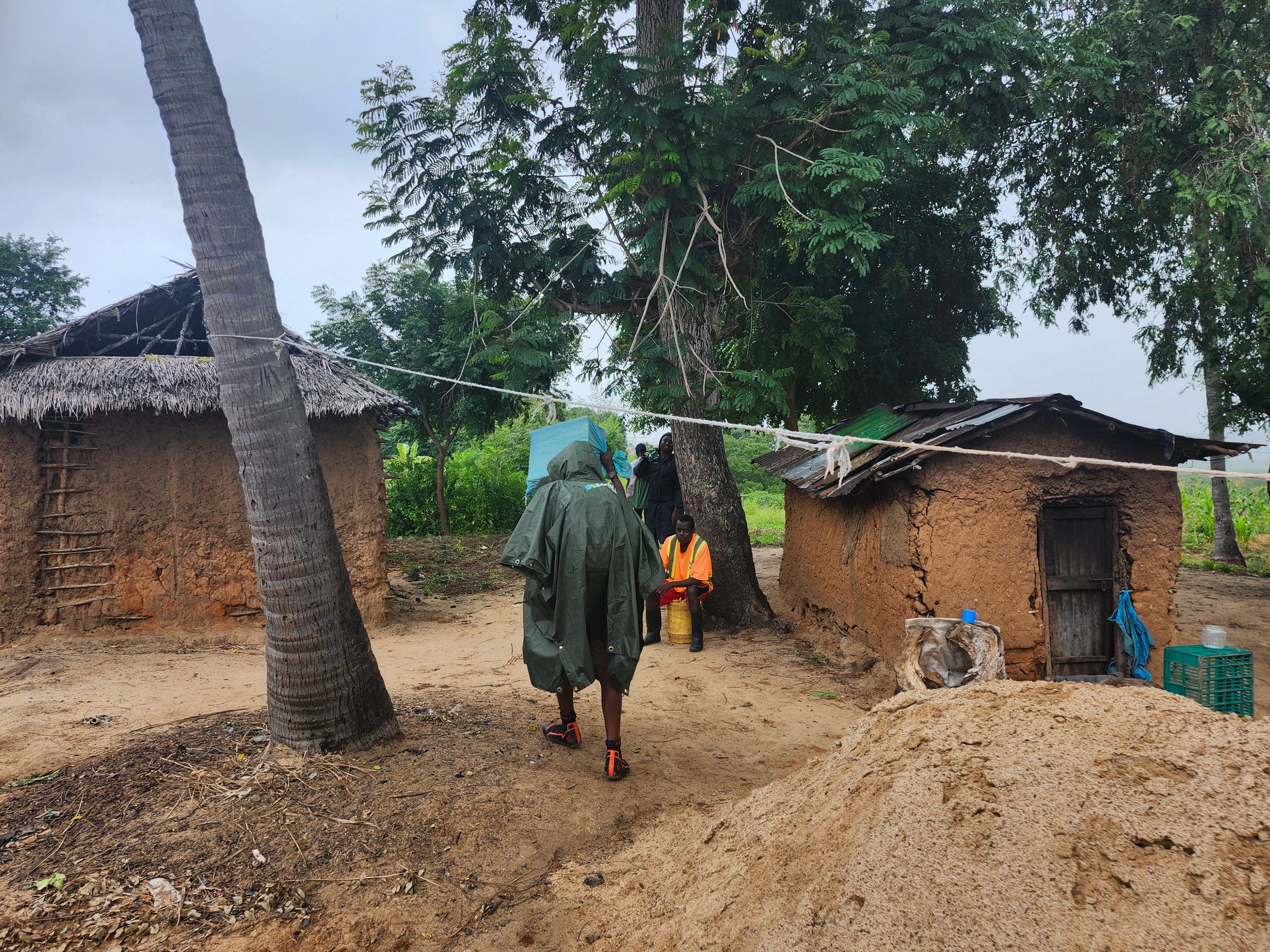
As we passed through a village down to the water’s edge on an eroded red-earth track, my lucky streak of avoiding the rainy season’s blasts on site visit days ran out. Rain came pouring down, in a brief but intense staccato of queued-up droplets.
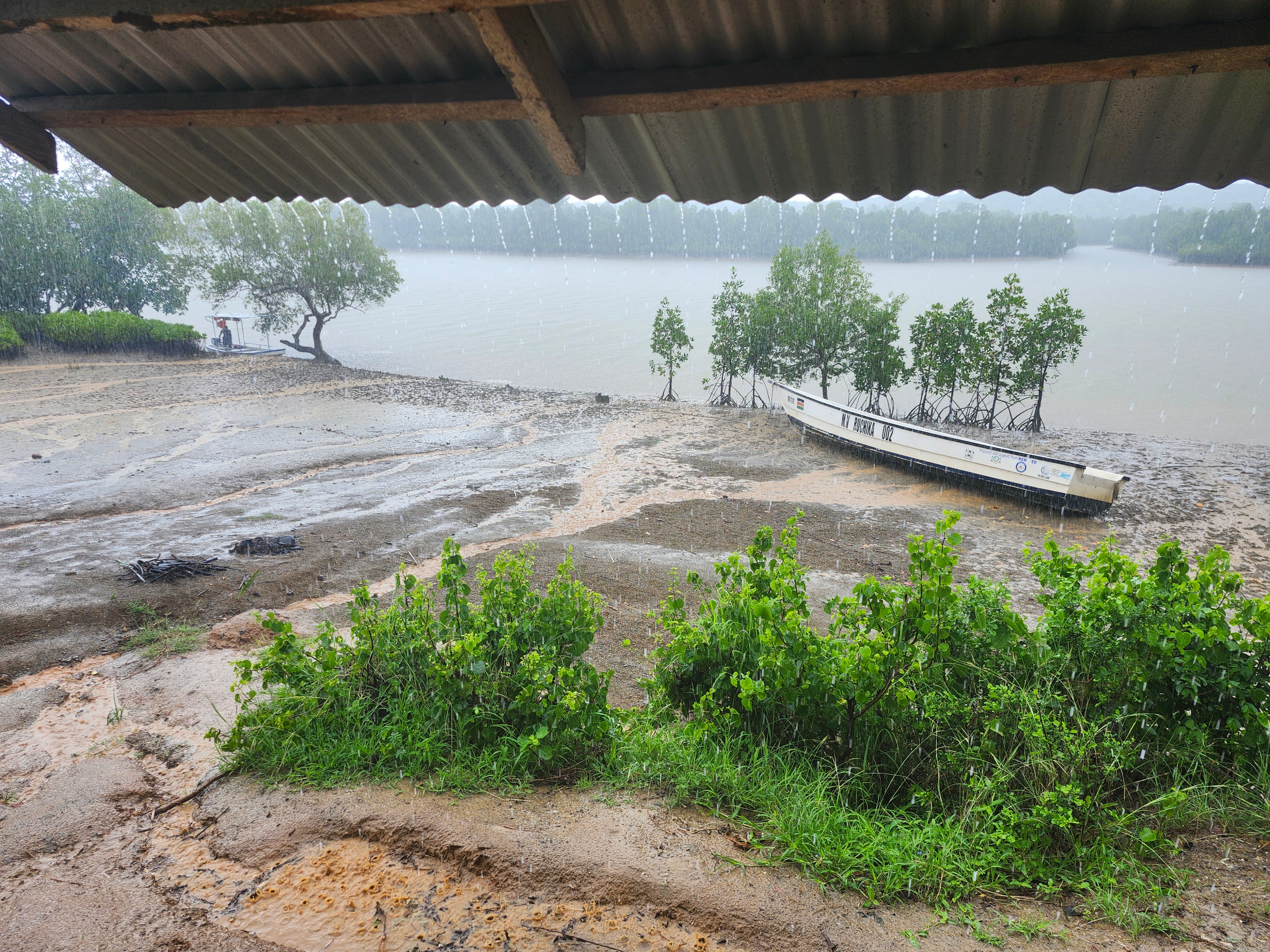
We paused to wait it out under a corrugated-iron shelter.
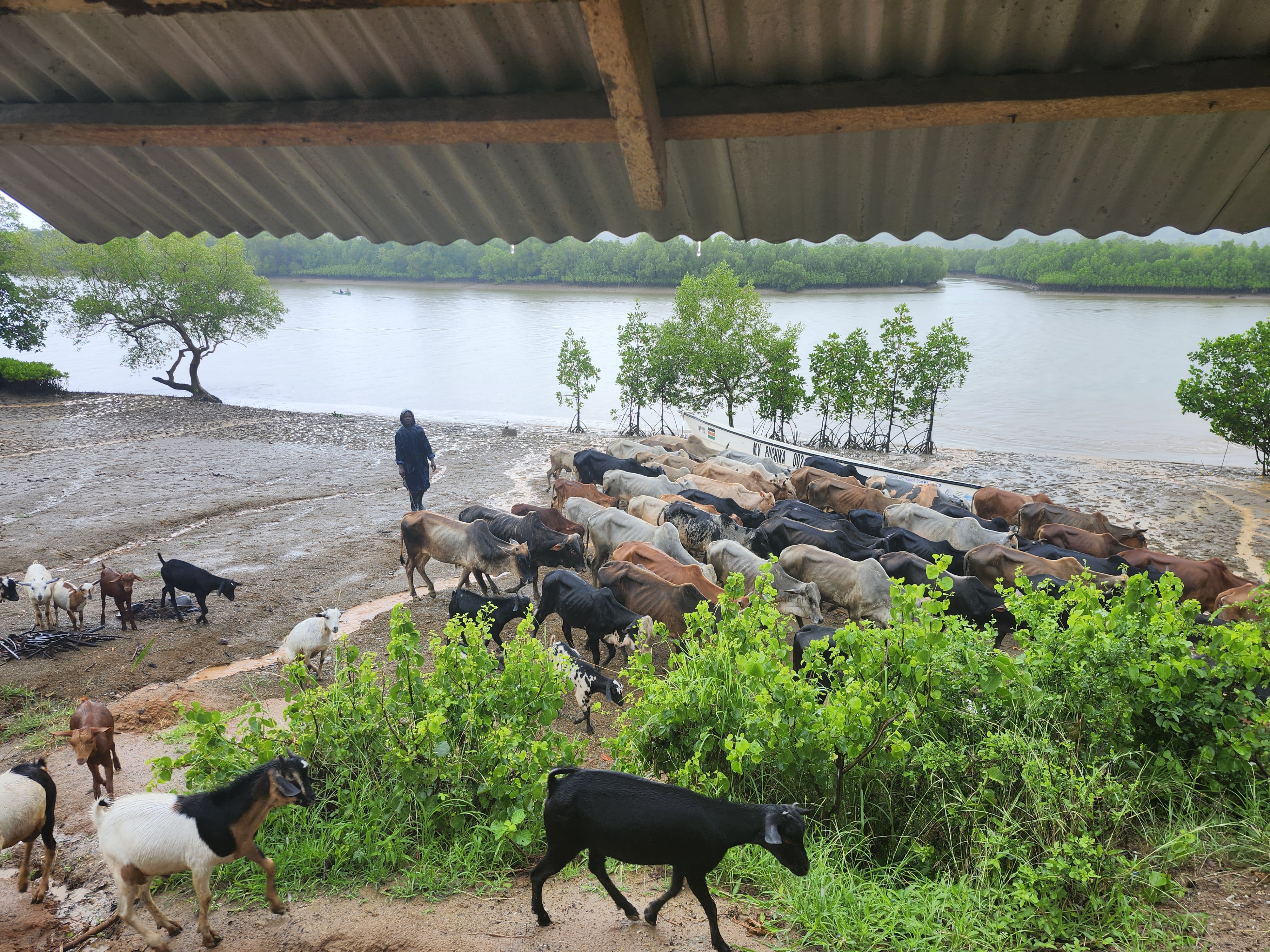
As the rain began to die down, a man drove a large herd of cattle and goats along the shore.
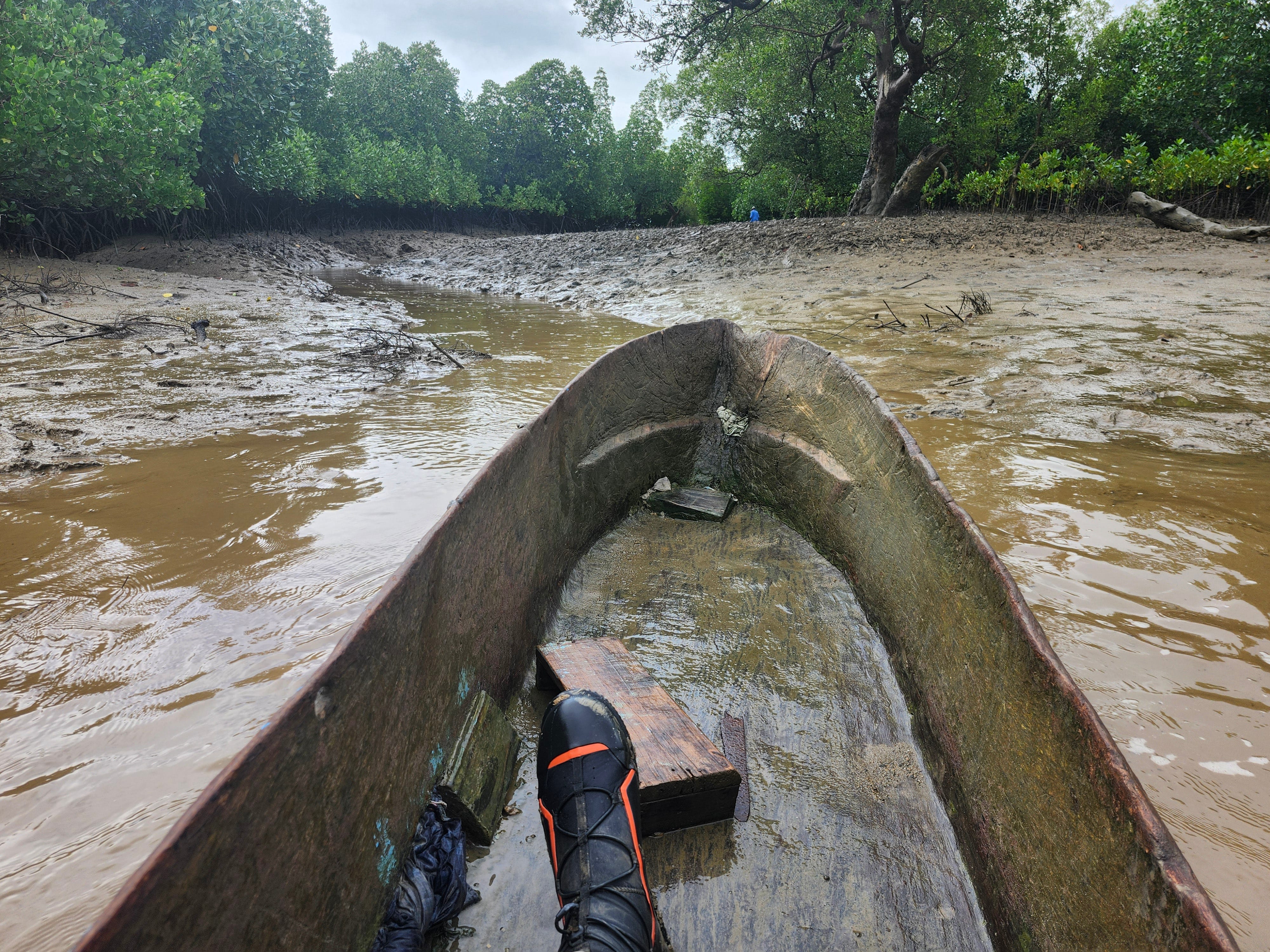
We then crossed the channel, the only water transport needed on today’s much shorter access journey. It was so shallow that we disembarked from a canoe. The mud was copious as usual, but not quite as difficult to move through as at the previous days’ sites. We were greeted by Athuman, the EarthLungs Site Forester managing operations at Mteza, and Bakari, the Mteza site lead tree production officer.
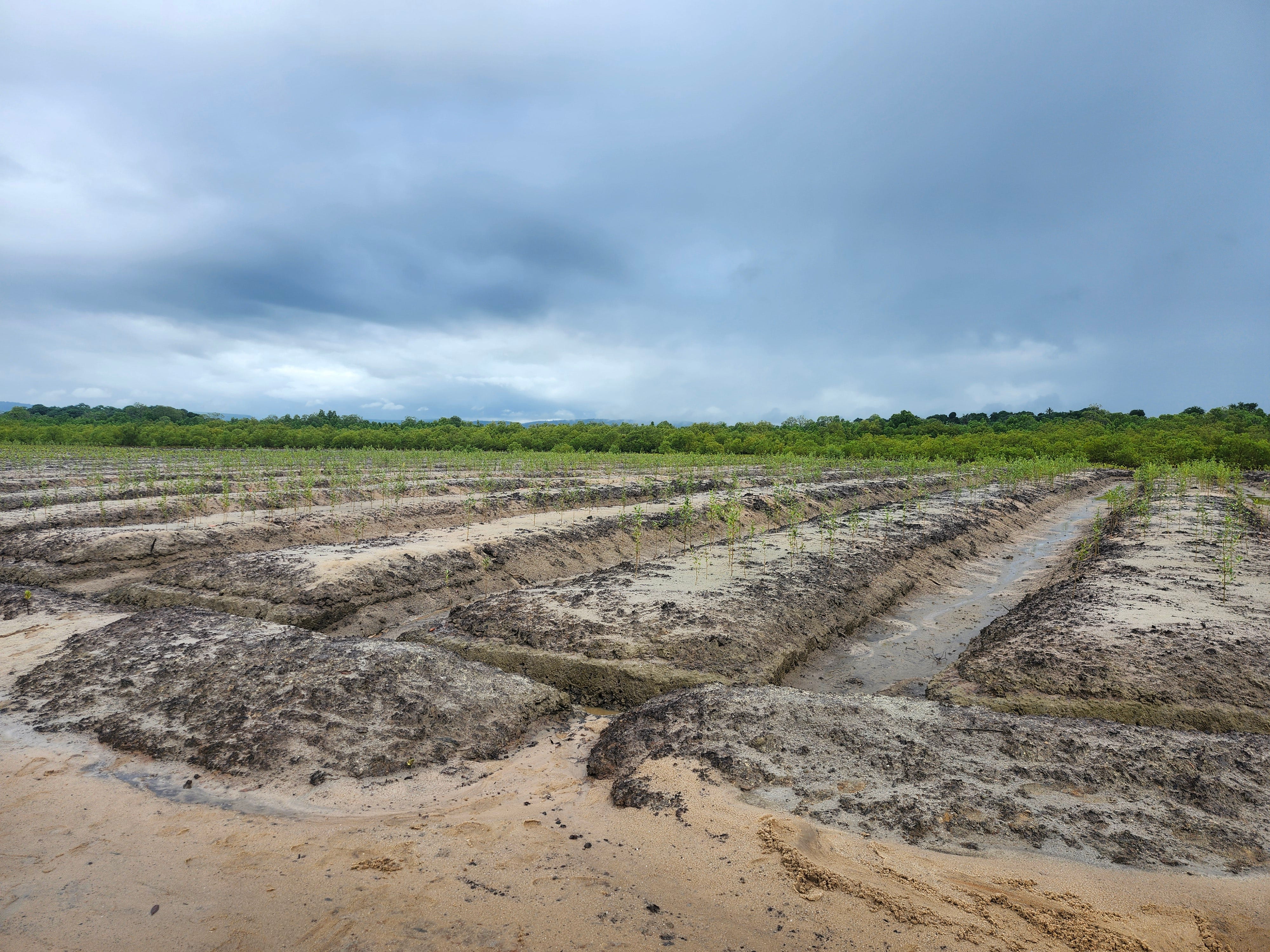
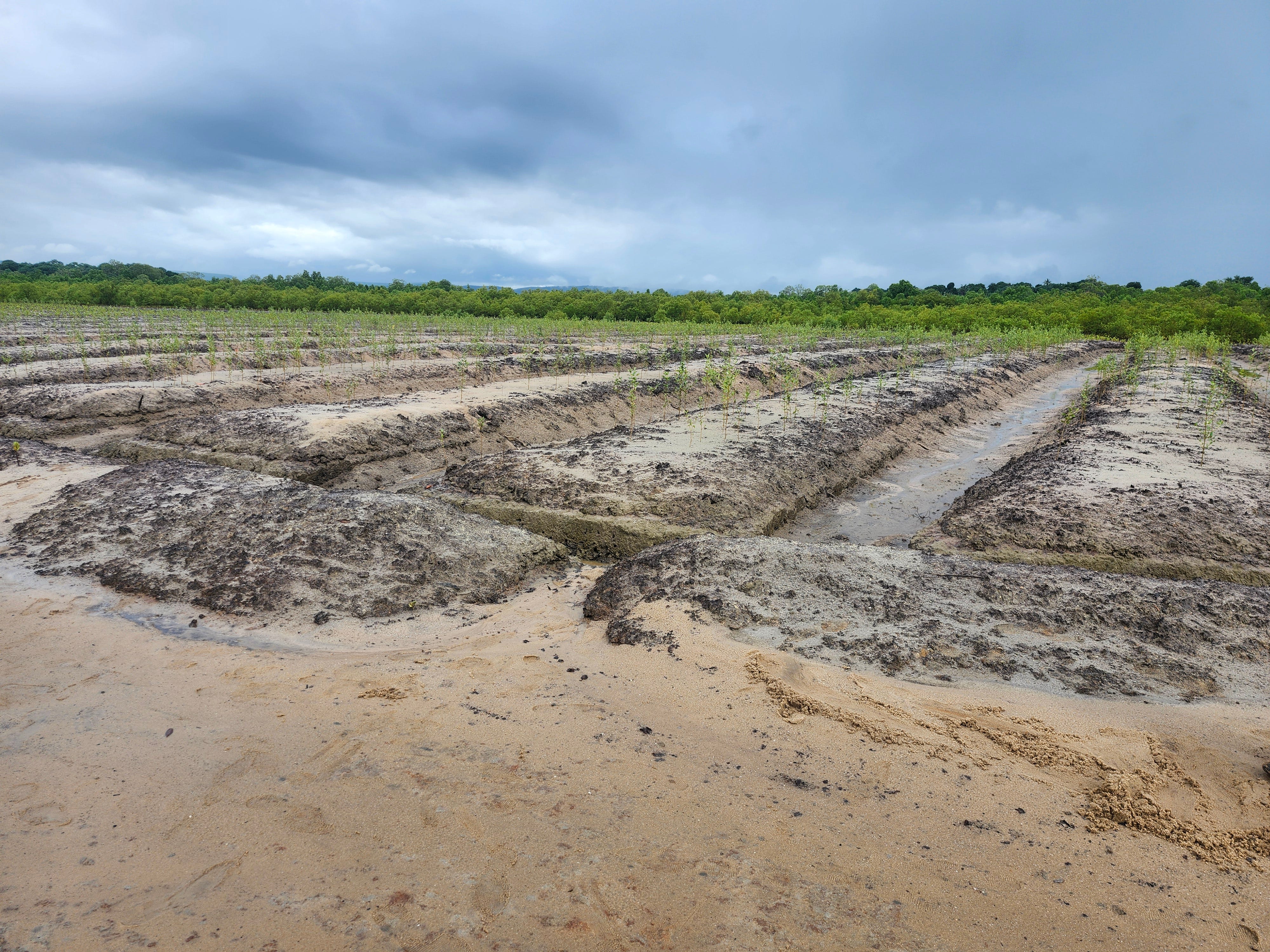
Soon, we came to a field of recently planted mangroves that looked very different from the ones I had seen so far in the previous two site visit days.
The mangrove seedlings here - Avicennia marina, a pioneer species - were planted on long raised hillocks. They were arranged in rows, with crabs frolicking in the little trenches separating them. A much bigger and deeper trench ran crosswise along the ends of all the rows and smaller trenches. Earthen berms separated that trench from the sandy plain we were walking on.
It had taken about 100 people, hired from the local communities, a cumulative three solid weeks to dig these new mini-landforms. EarthLungs had arrived at the site in 2023, the first trenches and plantings were done in 2024, and more trenches and plantings were completed in 2025. There were now fifteen permanent EarthLungs staff at Mteza, and dozens more hired part-time as needed.
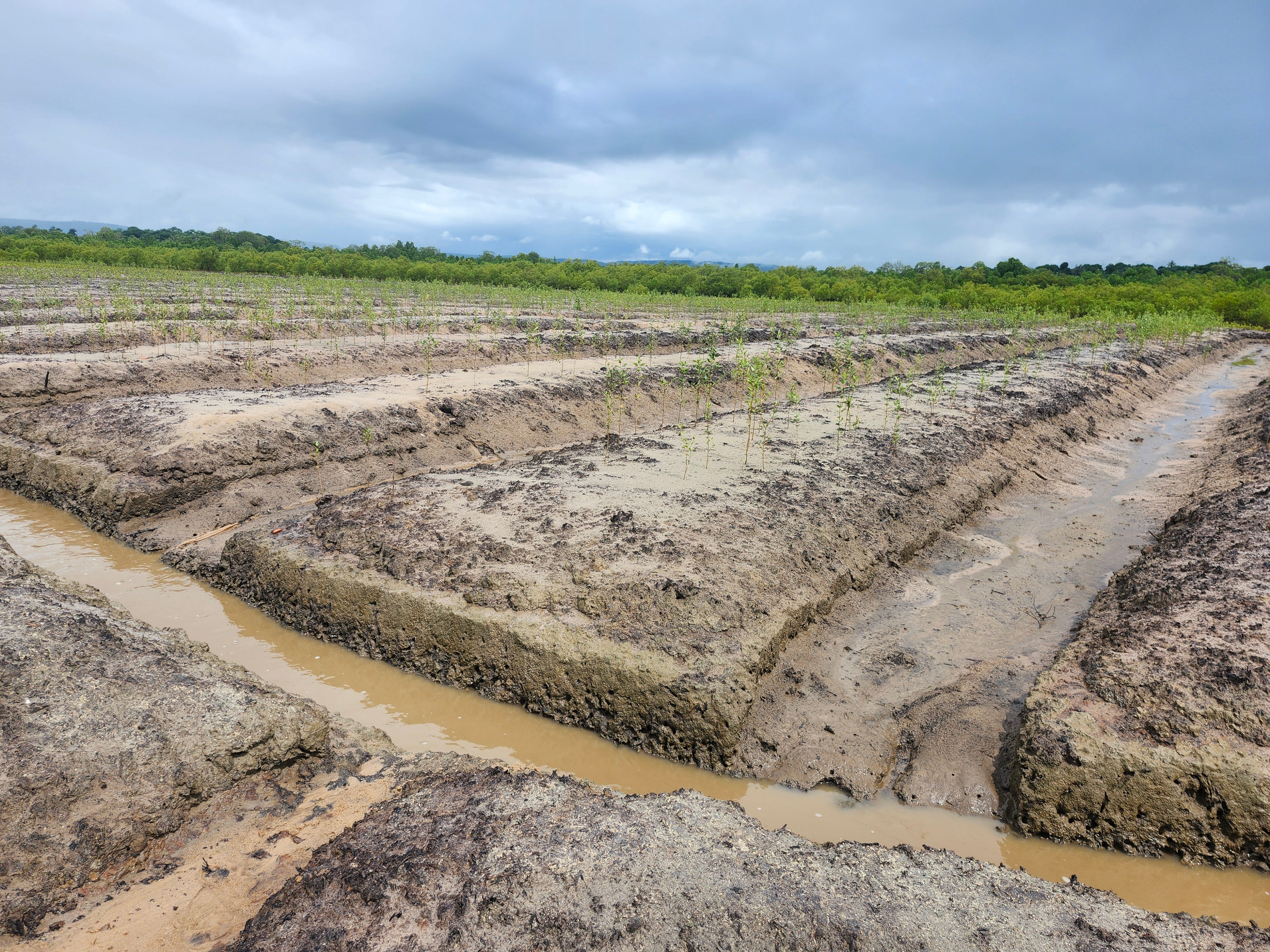
The trenches were needed at this Mteza site because of the particularly acute local siltation problem. When the brackish water rose at high tide, it was unusually full of sand and silt particles, and when it receded at low tide it left an infertile sandy layer atop the local clayey mud soils. The space where we were walking, to the left of the trenches dug throughout the planting area, was so covered in sand it almost looked like a beach. Sand buildup didn’t just reduce the fertility of the soils for new growth, it directly killed existing mangroves by blocking gas exchange when it covered their pneumatophore “breather” roots. (Not all mangroves have pneumatophores: particularly water-tolerant pioneers like Avicennia marina and Sonneratia alba do, while Ceriops tagal does not).
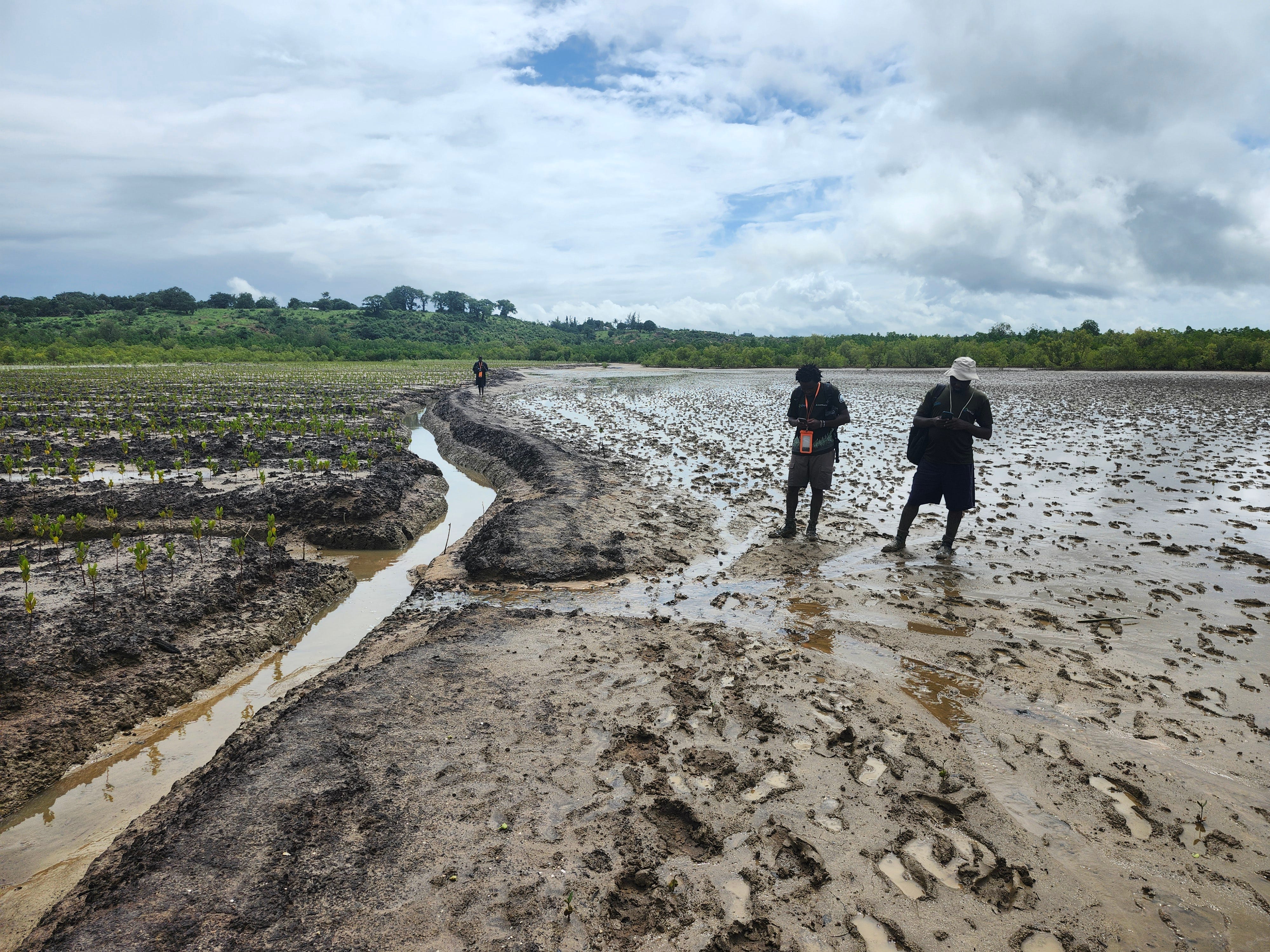
Here at Mteza, the siltation was building up, with increases in sand cover on a daily basis, and even more after rainfall. To some extent this is a natural process, but lately it’s become excessive and a threat to some mangrove ecosystems. Poor agricultural practices inland, like tilling land on steep hillsides without building terraces to reduce erosion, have made the silt problem gradually worse. Climate disruptions can bring the situation to a crisis point: the 1997-98 El Nino event had washed out a lot of extra silt to this area, which had killed a lot of mangrove trees.
The plan behind the trenches in this area was for the newly planted mangrove seedlings to grow in the hillocks richer clayey soil dug up to make the trenches, avoiding being smothered by the sand deposition. Over the years, the trenches would silt up with sand again, but that should take a while (the biggest one is two feet deep) by then the mangroves would be mature trees happily sequestering carbon and helping hold non-sand sediments and soil in place.
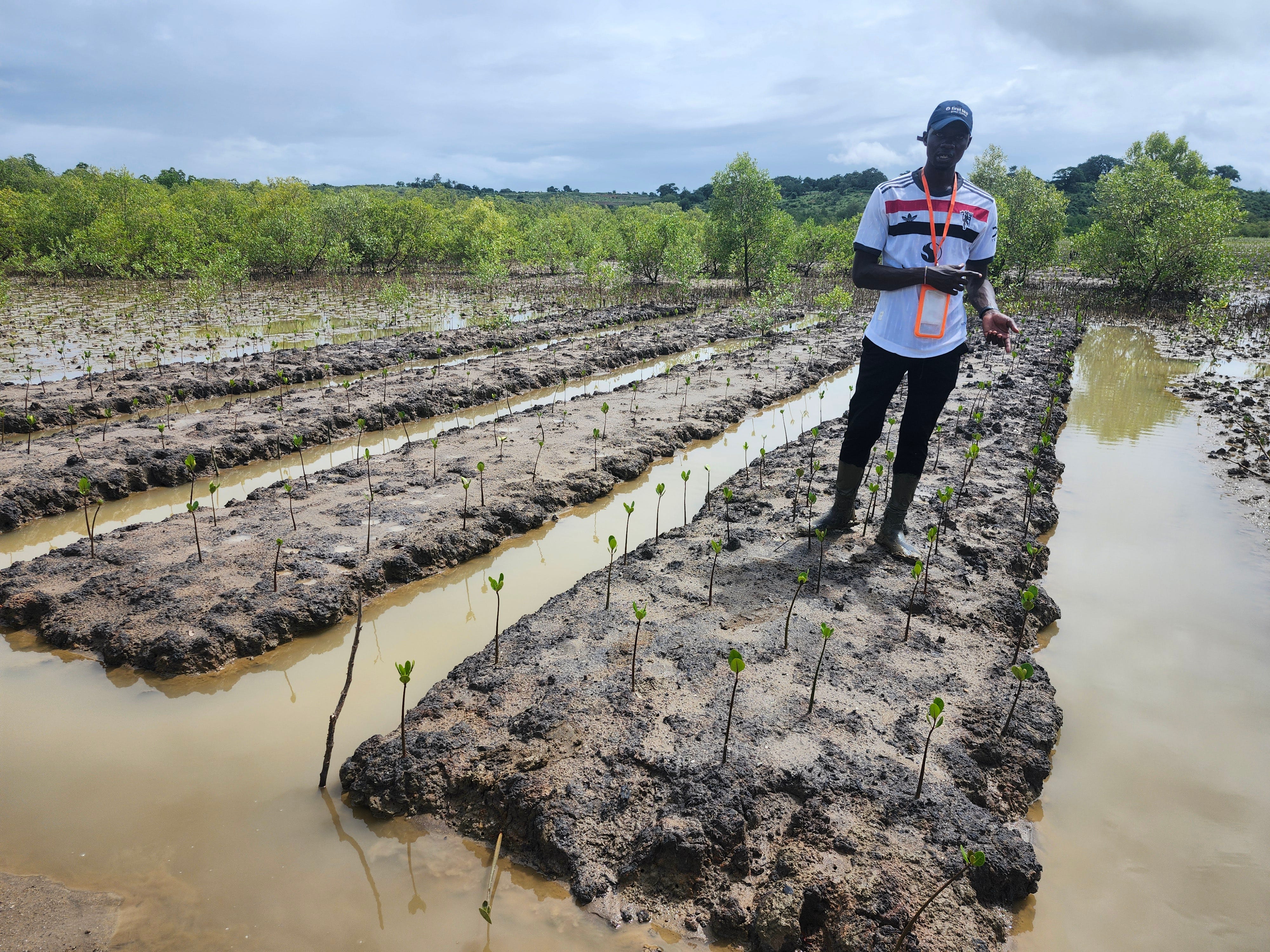
This wasn’t done haphazardly: there’s a lot to consider before any trenching activity or mangrove cultivation. Suleiman discussed with me the EarthLungs process when arriving at a new potential restoration site. Standard protocol was to do a vigorous site assessment. Talk to locals about which species were previously there, and the general biophysical history of the site. Check the biophysical factors, the still-existing species and where they were living. Measure the height and size of any trees present. Answer questions: what is the salinity in this area? What are the exact patterns of tidal influx and outflux in the local terrain? How does the water move, from where and to where?
This can be highly valuable. For example, Suleiman told me that during one pre-planting site inspection, EarthLungs had found wild Sonneratia alba, white mangrove, strangely high up and far from the water’s edge, outside its usual “zonation.” Further inquiries revealed that this patch had indeed once been a regularly flooded zone, but the channel through which the high tide returned had been blocked by silt, exacerbated by fallen trees accumulating more silt and acting as dams.
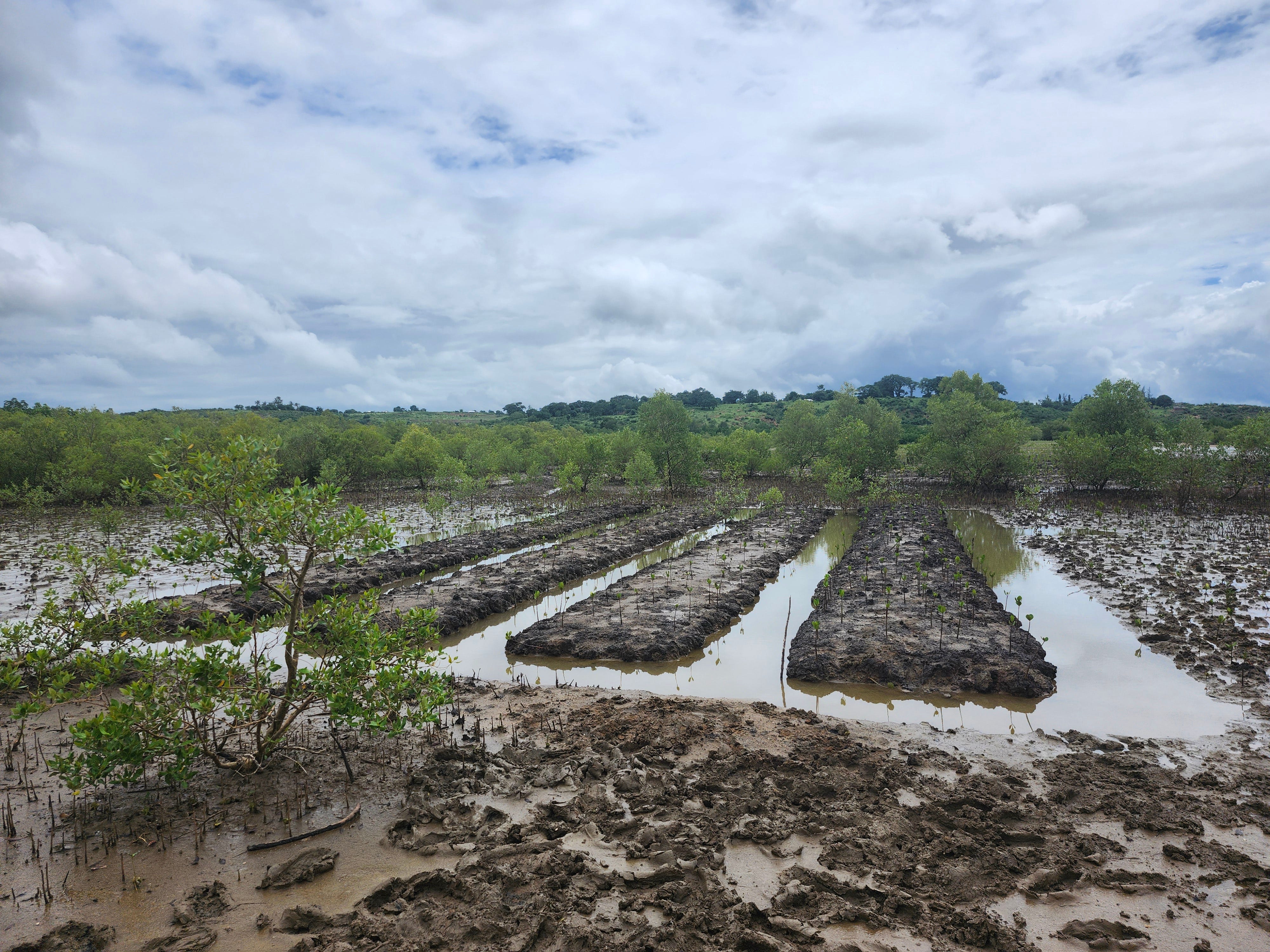
Next, we went to view a “potless nursery” section, where propagules were grown into more mature transplantable seedlings for the rest of the Mteza site. You could just push the “embryo-like” propagules into the soil, separated by 15 centimeters, then let them grow and later a corer tool to pick them up as ready-to-transplant seedlings. This was a relatively new part of EarthLungs operations, now being trialed in an effort to reduce plastic use. Athuman told me that local children now come to catch the fish left by the last high tide in the trench around the potless nursery. Sometimes flamingos drop by to fish there as well.
Mteza was only the second reforestation site EarthLungs had done work at, starting in 2023. (We were to visit the first site, Majaoni, the next day). It was the first site where they’d partnered with the Veritree monitoring and verification platform. Athuman and Bakari proudly explained the process. The EarthLungs site manager and/or monitoring officer uploads data on how many trees they’ve planted, their locations, their species, and in the course of time their survival rate, using geotagged photos as proof. The on-site staff do Level 1 verification (yep, what I just wrote down is correct), off-site Earth Lungs staff do Level 2 verification (yep, what those guys put in the system is correct) and the Veritree platform does Level 3 verification (yep, this latest update from our EarthLungs looks correct) with a range of technological verification options including satellite imagery.
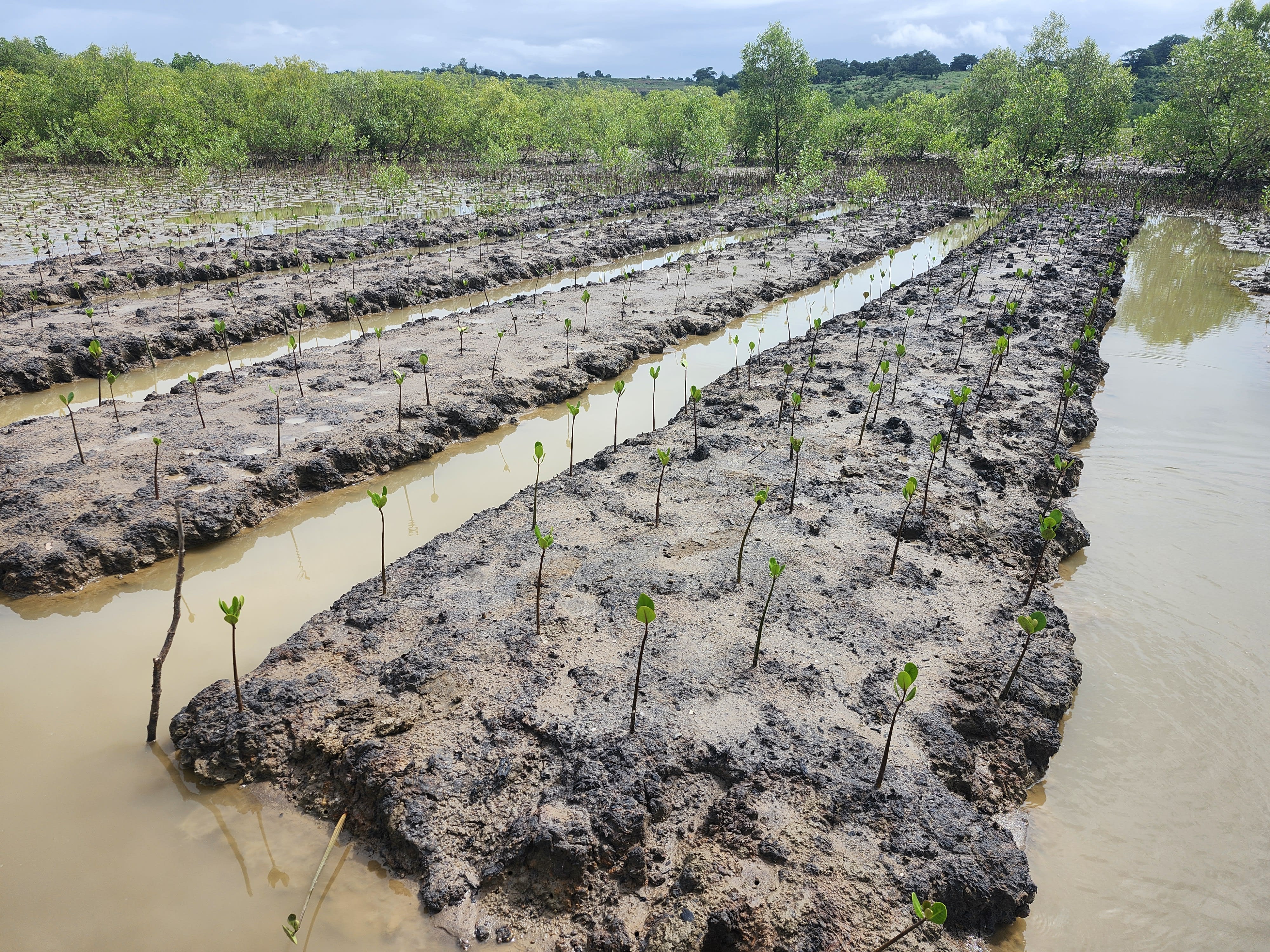
Standing in front of the potless nursery, I asked Athuman about his favorite part of working for EarthLungs. Without hesitation, he replied “The social impact.” When EarthLungs came to this Mteza site in 2023, much of the surrounding community was jobless, mainly spending their time fishing or cutting trees for charcoal. The income brought by EarthLungs’ regular “industry” of mangrove planting allowed parents to pay their kids’ school fees, and save money for the future. People learned about the importance of mangroves to the ecosystem. Tree cutting has spontaneously reduced, presumably thanks to both the education and the new income flow option.
EarthLungs even has an in-house “welfare” system for employees, where every month all staff have the option to contribute some small amount of money to a common fund. The contents of that fund can be loaned out to any EarthLungs staff that would like to borrow money at very low interest rates, helping empower people to make financial decisions without resorting to “loan sharks.”
And elsewhere on the Mteza site, too far to walk today, there were recently built beehives as part of the “Beyond Trees” program to ensure that communities employed by EarthLungs still had non-deforestation income-generating options once restoration work was complete. “Even in 30 or 50 years, the community will still benefit from this project.”
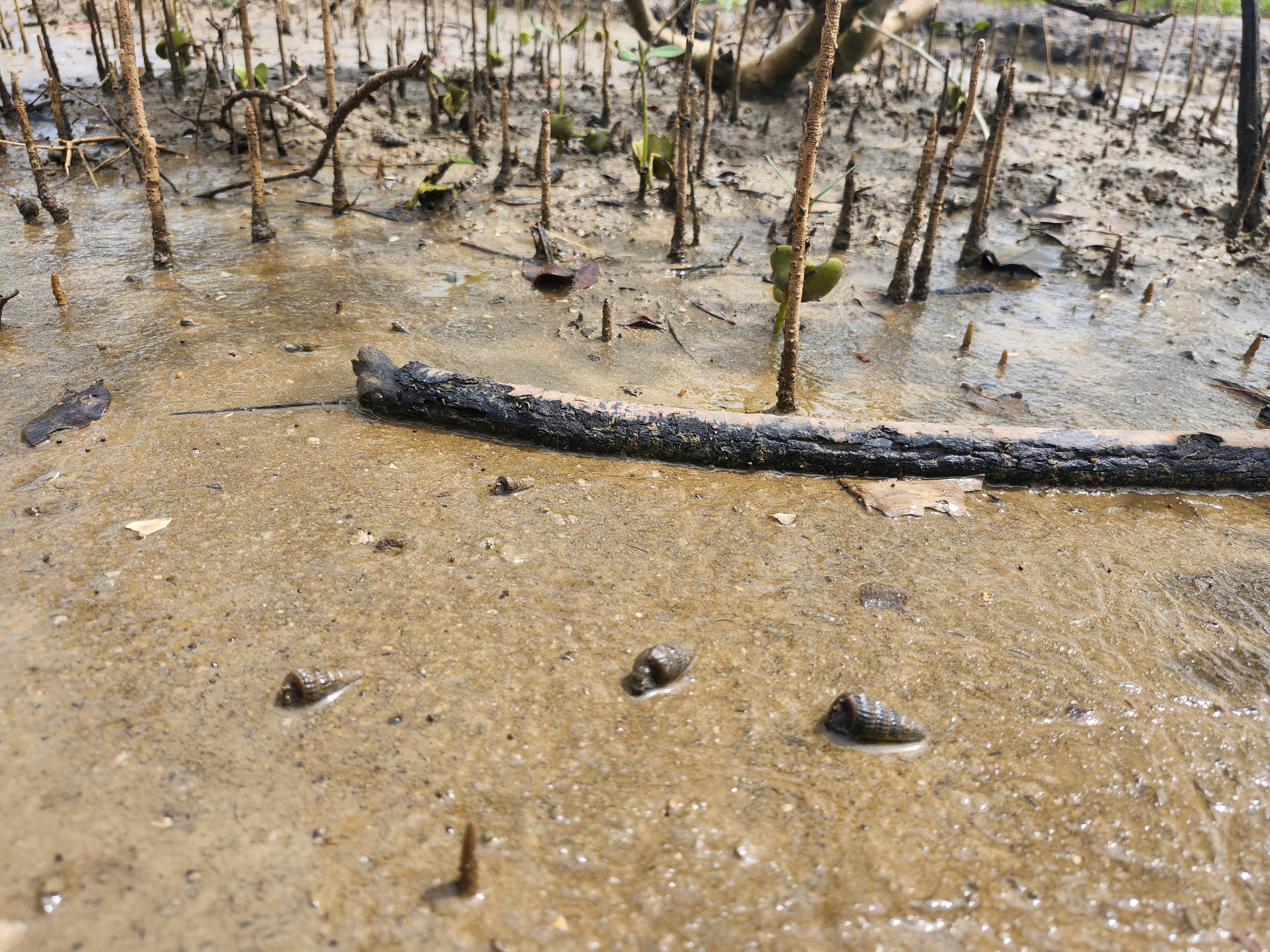
We then discussed the biophysical relationships, verging on symbiosis, between mangrove trees and the invertebrates of the mud flats. The omnipresent crabs have a nuanced effect: they will frequently eat mangrove propagules, and “crab predation” is one of the major causes of death for non-surviving trees planted, but they also are constantly digging tunnels in the mud to live, hide, and move in. These aerate and hydrate the soil, like a giant version of earthworms’ burrows, helping ensure good growing conditions. Overall, EarthLungs considers crabs to be a net benefit for mangroves, and notes high crab presence at potential future planting site as an encouraging sign for restoring ecosystem function. Shem told me that gastropods (snails) help mangroves by digesting fallen litter to give nutrients, and also help somewhat in aerating soils. No small mud animals present is a bad sign for future plantings.
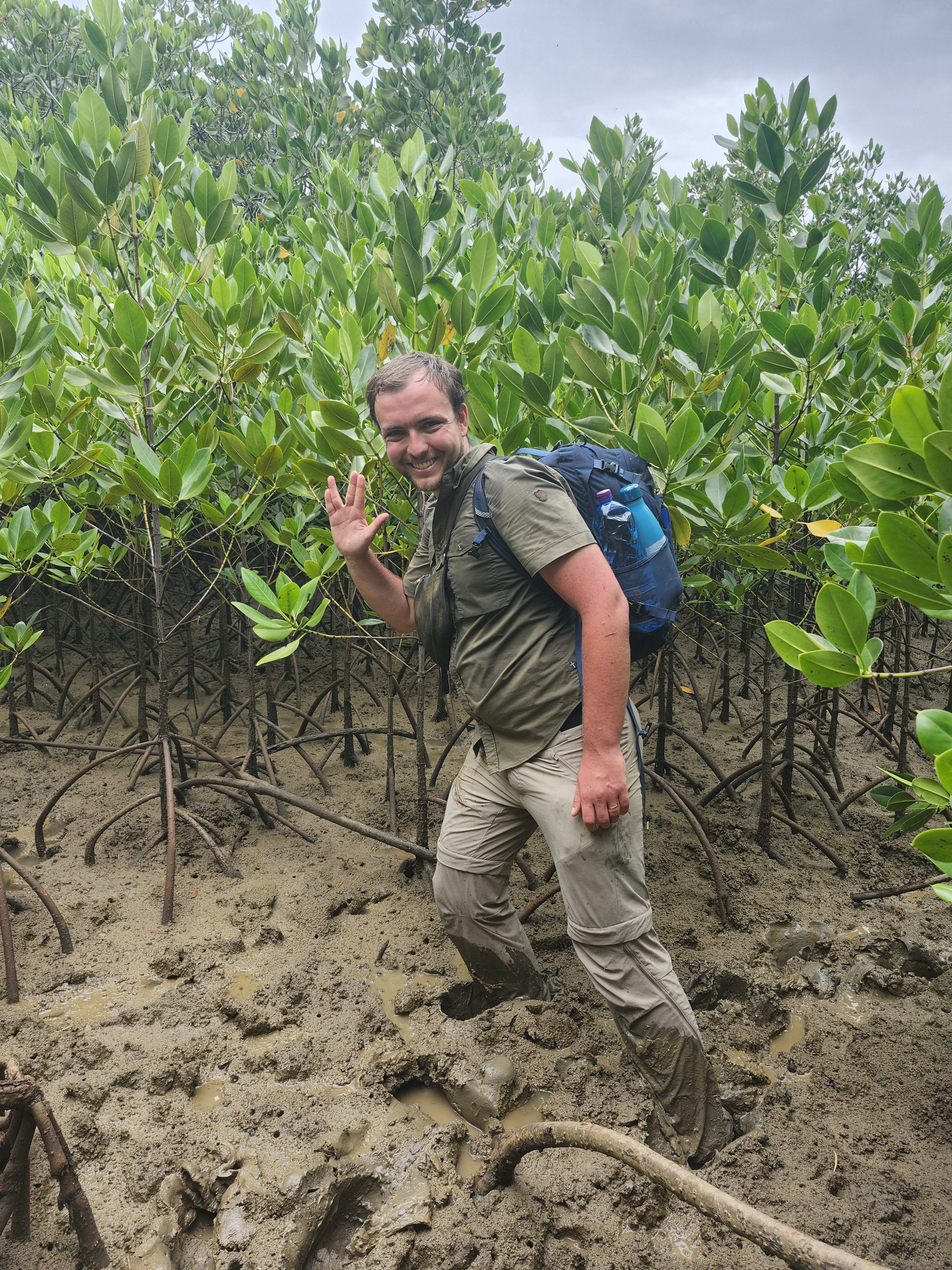
After the potless nursery, we went to see the first trees planted on this site, back when EarthLungs had arrived in 2023. The fast-growing Rhizophora mucronata loop-root mangroves were already taller than me!
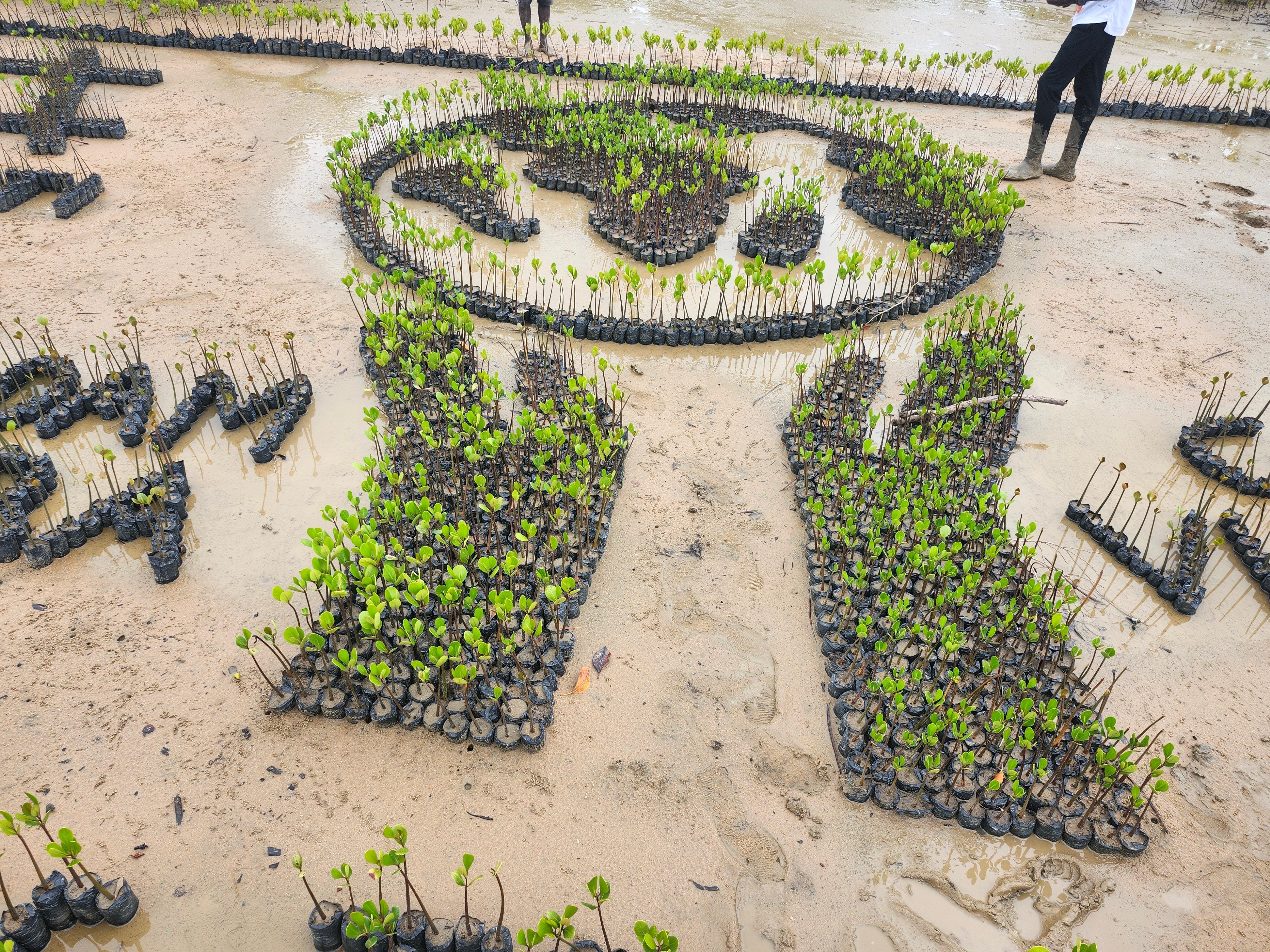
And finally, before we left, we checked out the non-potless nursery area, where the seedlings growing to planting size had been creatively arranged in a variety of charming shapes and patterns.
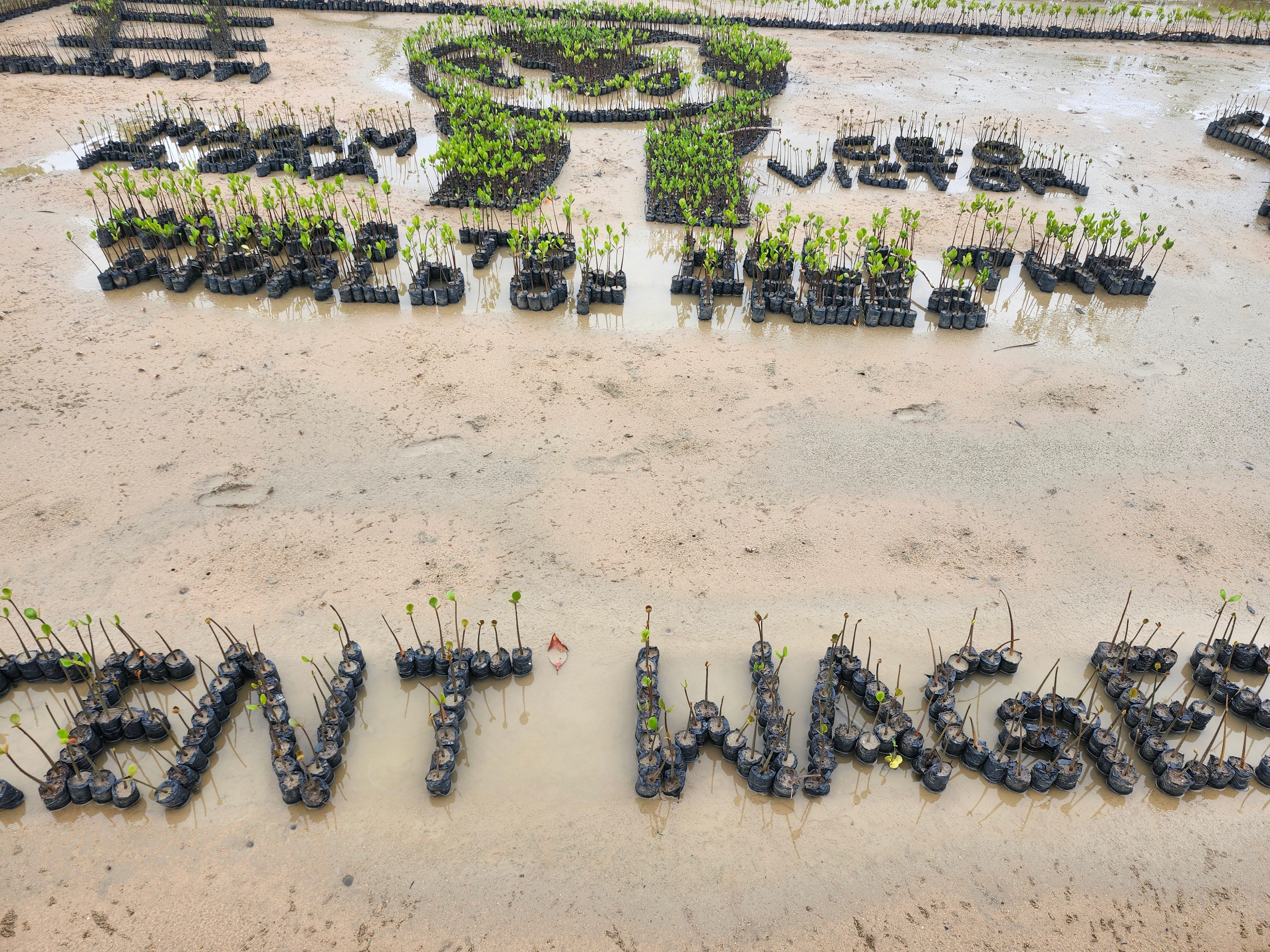
The names of a lot of people and organizations who supported the project. Slogans in Swahili and in English, including “Decent work for decent wages.”
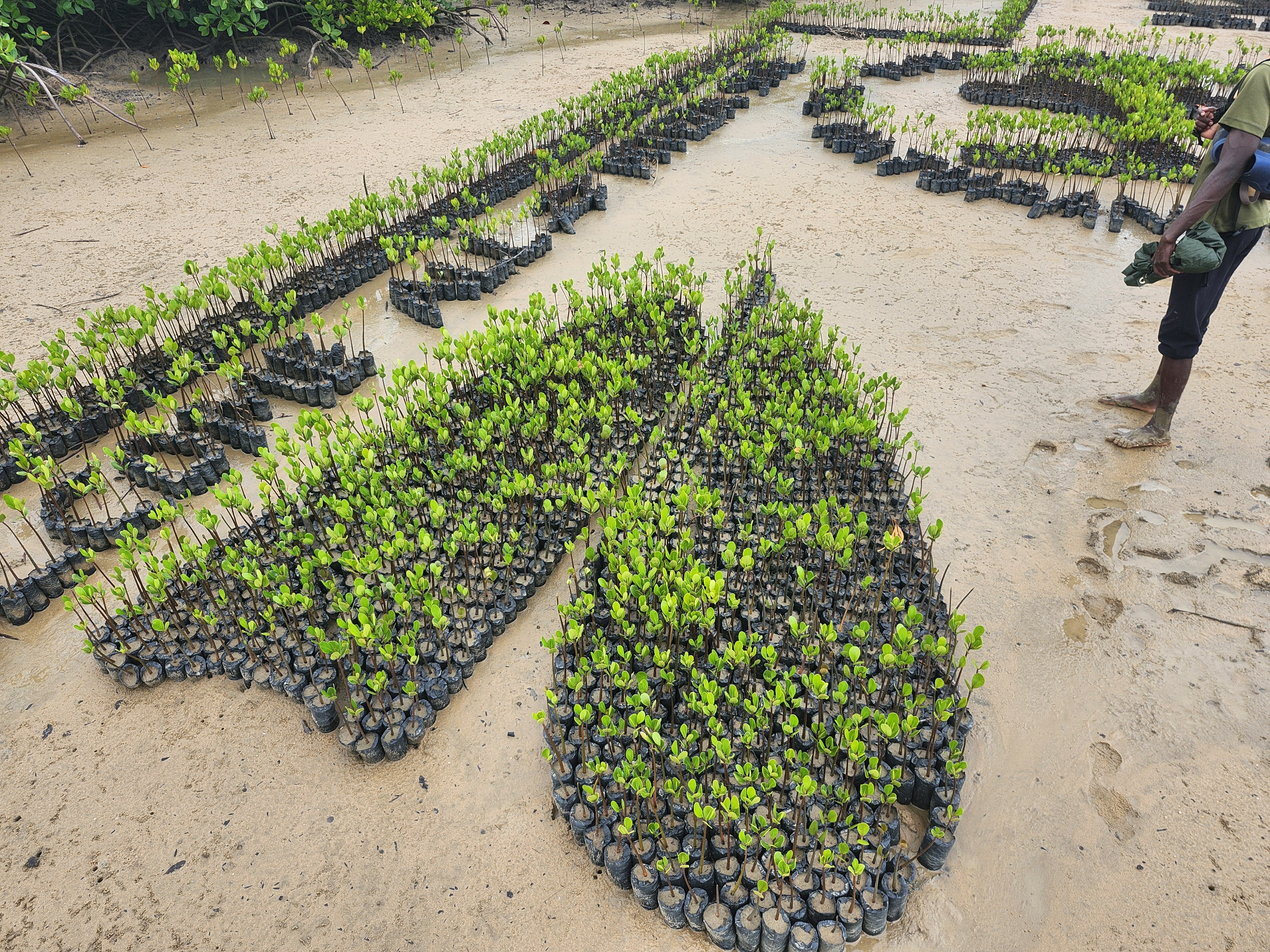
A pair of lungs, for EarthLungs. The Veritree V logo. A Kenyan coat of arms. A pair of hands holding a stylized image of planet Earth centered on Africa.
As we headed back to the boat, I reflected that this is what climate resilience looks like on the ground. Lots of careful thought about silt and currents and historic ecosystems, and a hundred people moving some mud around, and then a few years later, beautiful young life-rich forests instead of a sandy waste. Local landscape-scale ecological interventions may not be as shiny and glamorous as electric high-speed rail or a electric medicine-carrying drone or all the other exponentially diversifying wonders of the electrotech revolution, but they also really matter, and can be deeply, viscerally important to the lives of the people (and wildlife) that live nearby. Awesome work!
I love these stories of helping people by helping their environment! This is an awesome Substack! Thanks!
I’m appreciating & enjoying your journey, the vital work being done & the faces of folks you’re meeting. 🙏